1717 - 1869
History of the Faculty of Mechanical Engineering is closely related with that of the Czech Technical University. Subjects like mechanics of solid and fluid bodies and technical drawing were already taught at the Czech Engineering School of the Estates, where courses started in 1718. Further subjects were introduced after transformation of the school into the Czech Estates Polytechnic Institute, e.g. mechanical technology in 1860.
After approval of a new Statute many changes occurred at the Polytechnic in the Academic year 1863/1864. Consequently 1864 is also considered as the year of the establishment of the Faculty of Mechanical Engineering (FME). Primarily an independent mechanical engineering department led by a department head was established and also curricula were modified. The following subjects were taught : mechanical engineering, engineering technology, theoretical mechanics, machine construction, metallurgy and practical tutorials in mechanical engineering (excursions, training in department workshops and work experience in factories).
Gustav Schmidt was the first head of the department, Čeněk Hausmann was Professor of technical mechanics and machine construction, Jan Tille Professor of mechanical technology and Professor August Salaba gave lectures on encyclopedia of mechanics.
In the middle of the 19th century interest in study at the technical university, which at that time lasted 3 years, increased considerably. However, as a rule, many students did not finish their study. In spite of this the Prague Polytechnic was at that time the most frequently attended technical university in Europe immediately after a similar technical school in Vienna.
1869 - 1920
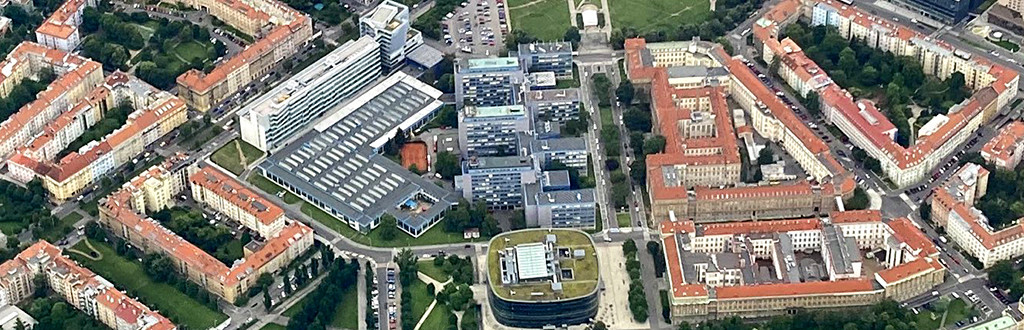
In 1869 the lasting disputes between the Czech and German members of the academic staff led to a split of the Prague Polytechnic into two independent colleges. In 1872-1874 a new building according to plans by architect I. Ullmann was built for the Czech college on Charles´ Square, where the FME still houses some of its departments.
After the Prague Polytechnic was put under the state administration in 1875, significant changes occurred in 1878. A system of two state exams was introduced and graduates obtained the right to use the professional title "engineer".
Students passed these exams for the first time in 1880 and this system was practiced until 1950. In 1879 the name of the Czech part of the Prague Polytechnic was changed to "Imperial and Royal Czech Technical University in Prague". The name of the German part was changed in a similar way.
In 1883 the following subjects were taught at the Department of Mechanical Engineering : mathematics, graphic geometry, theoretical mechanical engineering, machine construction, mechanical technology, encyclopedia of organic and inorganic chemistry, accounting. Courses in electrical engineering were introduced in 1901.
In 1901 the university was granted the right to confer the scientific degree "Doctor of Technical Sciences" and since 1904 rectors were officially addressed "Your Magnificenece" and since 1906 rectors gained the right to wear an honorary chain of office on the occasion of festive academic events. All these decisions were aimed at an increase of the the prestige of technical universities in the Austro-Hungarian Monarchy.
From the Academic year 1913/1914 the Department of Mechanical Engineering was split into the Department of Machine Construction and the Department of Electrical Engineering.
Training aids and equipment must also be mentioned. Collections of apparatuses for accurate measurement and mechanical models were multiplied under one of the first professors at the Department of the Czech Engineering School of the Estates – Franz Anton Linhard Herget. At the end of his era (Herget died in 1800) the engineering department had a large machinery hall, a mathematical museum and its own workshops and craftsmen. The collections comprised 250 apparatuses from the field of geometry, statics, hydraulics, 168 mechanical models, mining machines, agricultural appliances and also plans and maps for civil engineering. Further development of the collections and equipment of laboratories in which students were trained was the work of Josef Božek, a talented mechanic and inventor, who worked at the Prague Polytechnic. Steam engines, lathes, textile machines, models of equipment of metallurgical plants and glassworks were added. The collections served not only the interests of students but also craftsmen, manufacturers and entrepreneurs. Efforts to support practical education continued at the end of the 19th and in the first decades of the 20th century namely due to Professor August Salaba and later Professor Jan Zvoníček.
1920 - 1939
Further chnages occurred after World War I. The school was renamed "Czech Technical University in Prague" and comprised independent colleges headed by deans. The mechanical engineering department became the "College of Mechanical and Electrical Engineering". The field of mechanical engineering was divided into institutes which were later organized as departments. The number of departments and also teachers increased after the establishment of independent Czechoslovakia in 1918. In the Academic year 19221/1922 the college already comprised 26 independent departments with 22 professors. Courses were given on todays Husova Street(Prague Old Town), several years at the Liechtenstein Palace in Kampa (Prague Lesser Town) and later on Resslova Street (Charles´s Barracks) and on Charles´s Square, where after 1918 the yard started to be built-up and in 1926 machine laboratories were opened there.
1939 - 1945
During World War II when Czechoslovakia was occupied by the Nazis, the Czech Technical University similarly as all Czech universities was closed-down and lectures were not resumed until the end of the war in May 1945.
Since 1945
The first Higher Education Act was issued in 1950 (3 further Acts until 1980) followed by a new Statute of the Czech Technical University. Technical universities similarly as non-technical universities were divided into faculties which comprised institutes formed by the unification of smaller former units. New scientific degrees were introduced – after a successful dissertation conferment of the scientific degree "Candidate of Sciences" (abbr. "CSc.") and a higher scientific degree "Doctor of Sciences (abbr. "DrSc.").
The CTU comprised 8 faculties : engineering construction, architecture and land construction, mechanical engineering, electrical engineering, chemical engineering, agricultural and forestry engineering, special disciplines and commerce (the chemical faculty, the agricultural and forestry engineering faculty and the faculty of commerce became independent universities in 1952). New faculties were established at the Czech Technical University : radiotechnical faculty, faculty of forestry, faculty of geodesy and faculty of engineering economics.
The Faculty of Mechanical Engineering in its present form was established in 1951 with 12 study programmes : construction, transportation and lifting machines, automobiles and tractors, agricultural machines, piston machines; cooling technology; boilers; projecting, construction and running of thermal power equiment; heating and HVAC; chemical and food production machines; mechanical engineering technology; machining, machine tools and metal forming machines; precision mechanics and optics; industrial experience.
The length of the full-time form of study was 10 semesters. (8 semesters basic study and 2 semesters specialized study). Available were also extramural forms : evening study from Academic year 1951/1952, correspondence study from Academic year 1952/1953, special extramural study for innovators from Academic year 1955/12956 (shorter – with the aid of a permanent tutor – mainly theoretic subjects). At the end of the 1950s the faculty comprised 18 departments (some of them divided into smaller divisions) and 2 sections (military and political economy).
From 1960 the CTU comprised only 4 faculties . The following subjects were taught at the Faculty of Mechanical Engineering : mechanical engineering technology; thermal power equipment; motor vehicels and piston mechines; construction, lifting and transportation machines; agricultural machines; machine tools and metal forming machines; heating, ventilation and cooling equipment; chemical and food production machines; precision mechanics and optics; economics; organization and mechanical and electrical production planning.
At the beginning of the 1980s the name of the faculty changed to "Faculty of Mechanical Engineering of the Czech Technical Universityin Prague". Up till 1998 it comprised 33 institutes. The result of the last reorganization in 1998 was the establishment of 15 departments which originated by a merge of existing professionally related institutes. The departments comprise divisions the professional and tutorial orientation of which continues in the orientation of the former institutes.
Some eminent personalities of mechanical engineering :
- František Hasa (1863-1945) – mechanical technology (established mechanical workshops), from
1908 Professor of mechanical technology,
- Jan Zvoníček (1865-1926) – steam turbines, from 1912 Professor of machine construction,
- Jaroslav Hýbl (1882-1950) – cooling machines and water power engines (hydraulic machines and
mechanical cooling), from 1908 Professor of theory and construction of steam turbines,
- L. Miškovský (1893-1953) – steam engines and turbines,
- Viktor Felber (1880-1942) – technical mechanics and thermomechanics,
since 1967 Commemorative Felber Medal awarded for distinguished contributions to the
development of the CTU (3 classes – Gold, Silver and Bronze),
- Karel Spála (1875-1953) – parts of machines,
- Otakar Maštovský (1900-1985) – hydromechanics,
- Josef Šrejtr (1901-1968) – technical mechanics,
- Otakar Balcar (1883-1968) - cranes and transportation machines,
- Vojtěch Jareš (1888-1965) - metallography,
- Zdeněk Horák (1898-1987) – physics.
The scientific work of members of the academic staff of the College of Mechanical and Electrical Engineering and their cooperation with industry was from the end of the 19th century all the more important because up till 1945 only the ŠKODA WORKS in Plzeň had their own research establishment. It was Professor František Hasa who invested a great deal of effort into the establishment of research laboratories at the College. In the 1920s such laboratories were established and equipped with machines and apparatuses mainly obtained as presents from industrial enterprises.
The Czech Technical Foundation, whose members were closely related with the CTU was founded in 1925 to support publishing of technical literature. Besides the magazine "Mechanical Engineering Horizon" a series of "Technical Handbooks" started being published and are still published until now.
The Engineering School of the Estates was formed side by side with the development of technology and economy in the world and from the beginning also with respect to the level of European technical education. Willenberg´s proposal to establish an engineering school was first in a series which followed shortly afterwards – similar schools were established in Vienna, Brussels and Paris. And particularly the Polytechnic in Paris was a model for modifications of the Engineering School of the Estates enforced by Gerstner in 1803. Gerstner established scientific contatcs even in England.
Already before 1918 the school was open to foreign students, namely from Slavonic countries. Most of these students came from Yougoslavia, Bulgaria, Poland, Romania, Russia and Ukraine. At the end of the 1950s under the communist regime foreign relations extended namely with technical universities of Eastern Block countries. Scientific conferences, student mobility, internships and excursions were organized. Particularly close were contacts with partners in Dresden, Budapest, Warsaw, Bucharest, Sofia, Leningrad (now St.Petersburg) and Tbilisi. Social and political changes in 1989 made it possible to extend foreign relations and international scientific cooperation with Western European countries and North America. The Faculty of Mechanical Engineering was involved in international scientific programmes, e.g. TEMPUS, SOCRATES, LEONARDO da Vinci, ERASMUS, 4th, 5th and 6th Framework Programme, etc.and after the admission of the Czech Republic to the EU in 2004 also in further EU programmes.
The Faculty of Mechanical Engineering of the CTU in Prague presents commemorative medals to staff members and faculty teams :
- Medal of the Faculty of Mechanical Engineering (CTU in Prague) - for significant contributions
to the development of the Faculty of Mechanical Engineering (CTU in Prague), achievements in the
field of science and research, education, organization and economy and for contributions to the
development and improvement of the status of mechanical engineering.
- Professor Jaroslav Hýbl Medal - highest recognition of significant achievements in the
development of mechanical engineering, development and presentation of the Faculty of
Mechanical Engineering .
- Professor František Hasa Medal - for significant contributions to the development of the Faculty
of Mechanical Engineering in the field of manufacturing technology, management and work
experience.
- Professor Karel Spála Medal - for significant contributions to the development of the Faculty
of Mechanical Engineering in the field of principles of mechanical engineering.
- Professor Jan Zvoníček Medal - for significant contributions to the development of the Faculty
of Mechanical Engineering in the field of design and construction of machines.

Authors : PhDr. Ludmila Tichá, Doc. JUDr. František Klimeš, CSc., Doc.Ing. Zdeněk Kuliš, CSc. Prague June 20, 2001
Update and translation : Ing.Ivan Šiman, CSc. June 9, 2005